Why access to information depends on
using the tools we already have, properly.
What the pikelets taught me.
Last week, I told the story of my attempt to make pikelets using an electric frypan. The electric frypan was not the problem. It worked perfectly well. The recipe was there, the instructions were there, and the frypan was there. The problem was that I did not put everything together properly. If I had followed the recipe and used the frypan properly, I would have had pikelets. I also would not have gotten into trouble with Mum.
It is a simple example, but it makes a much bigger point about information. The information can be available and the technology can be available, but what matters is how we use them together. We can see this throughout the history of written communication.
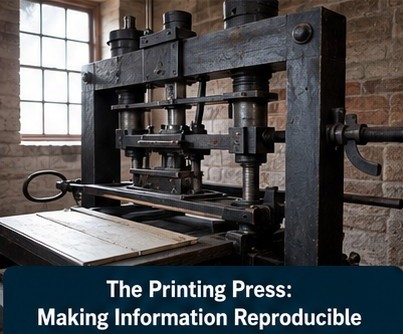
Around 1440, Johannes Gutenberg developed his movable-type printing system in Mainz, Germany. Printing itself was not new. Woodblock printing had been used in China for centuries. The Diamond Sutra, printed in China in 868, is generally recognised as the oldest known complete printed book.
What Gutenberg’s work changed was the ability to produce large numbers of printed pages in Europe. Instead of a book having to be copied by hand, multiple copies could be produced. Ideas could travel further, books could reach more people, and information could be shared on a much larger scale.
But the printing press did not decide what language should be used. Much early European scholarly and religious material was printed in Latin. Latin was important, but it was not the everyday language of most people. The printing press could produce hundreds of copies, but if those copies were in a language that most people could not understand, the information was still difficult for them to access.
The machine was capable of spreading information. The question was how people chose to use it.
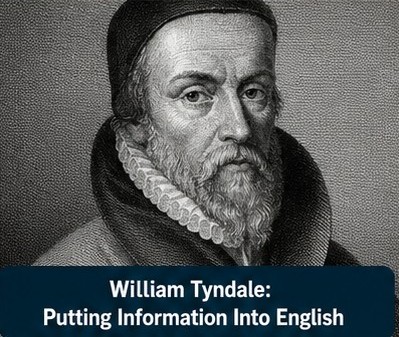
This is where William Tyndale becomes an important part of the story. Tyndale was an English scholar and translator who believed that people should be able to read the Bible in their own language. During the 1520s, he translated the New Testament into English from the original Greek. He then used the printing press to reproduce his translation.
His English New Testament was first printed in 1525 or 1526, with an important edition produced at Worms in Germany. The printing press had already been invented. Tyndale did not need to invent another machine. Instead, he changed the way the machine was used.
He put the information into English and then used the printing press to produce copies. That meant written information could reach people who could not read Latin. Tyndale’s work was controversial and dangerous. He was eventually executed in 1536. His translation nevertheless had a lasting influence on later English Bibles.
His story makes an important point. The technology was capable of distributing the information. Someone had to make the information available in a form people could read.
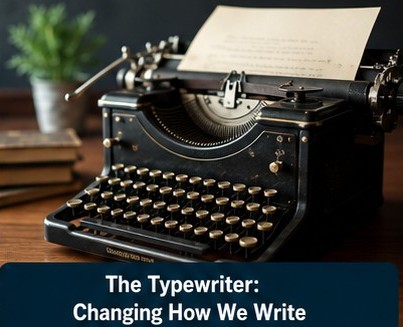
The next change came with the development of mechanical writing machines. The history of the typewriter is complicated, with several inventors contributing to its development.
One early example comes from Italy. Around 1808, Pellegrino Turri is credited with developing a mechanical typing machine for his blind friend, Countess Carolina Fantoni da Fivizzano. Earlier work by Agostino Fantoni may also have contributed to its development.
The important part of the story is that the machine enabled written communication in a different way. The typewriter eventually became much more than a machine for one person’s needs. By the late 19th century, commercial typewriters were becoming common in offices and businesses. People could produce letters and documents much faster than writing everything by hand.
The technology had changed the process of creating written information. It also shows us something else. A tool does not have to remain limited to the purpose for which it was first created. People find new uses for technology.
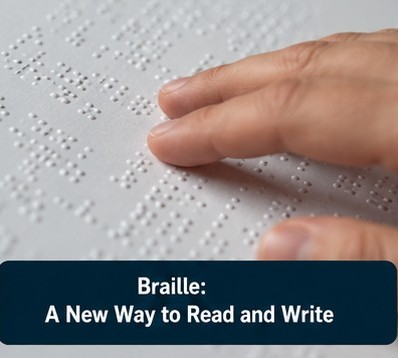
In 1824, Louis Braille developed the basic system of raised dots that became Braille. He was only a teenager. Braille had lost his sight as a young child and later adapted a tactile code developed by Charles Barbier for military communication. By 1829, he had published his method.
For people who were blind, this created another way to communicate through written language. Words could be represented through raised dots rather than printed letters. A person could read, write, take notes, study and record information.
The important change was not simply the invention of a new system. It was that written information could now be represented in a form that could be read through touch. The information remained information. The method of communicating it changed.
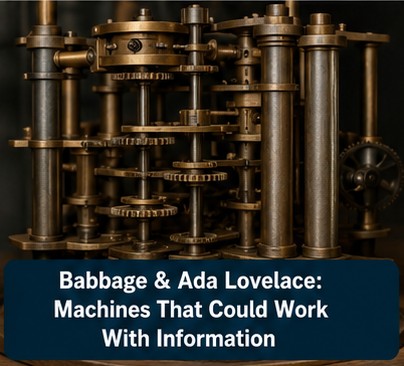
In 1837, Charles Babbage described his design for the Analytical Engine. The machine was never completed, but the design included ideas that would become important to computing, including memory, processing and instructions. Babbage was thinking about calculation. He was not designing a machine to help people communicate.
But then Ada Lovelace saw another possibility. Lovelace was a mathematician who worked with Babbage’s ideas about the Analytical Engine. In 1843, she published notes about the machine that included a detailed set of instructions for calculating Bernoulli numbers.
Her work showed something important. She was not just looking at what the machine was. She was thinking about what the machine could do. Babbage had designed the machine, and Lovelace created a way of telling the machine what to do.
Her instructions are an early example of what we now call an algorithm or computer program. More importantly for this story, she helped demonstrate that the machine could be used to process information according to a set of instructions. She also imagined that machines like the Analytical Engine might eventually work with things beyond numbers, including symbols and music.
The machine was there. Lovelace helped show how it could be used. That idea would become very important more than a century later when computers became everyday tools for creating, storing, processing and sharing information.

In 1989, British computer scientist Tim Berners-Lee proposed the system that became the World Wide Web while working at CERN. He wanted a better way for information to be connected and shared between researchers.
The first web server and browser were running by 1990. The Web then spread beyond CERN, and in 1993, CERN placed the Web software into the public domain. That decision was important because technology could now be used, copied and developed by others without having to pay CERN for it. This helped the Web spread around the world.
Written information could now be published and connected across countries. A person could create information in one country and someone thousands of kilometres away could read it. A business did not need its own printing press, and a writer did not need a traditional publisher to put their words online.
Information could move at a speed that earlier generations could never have imagined. And Tim Berners-Lee summed up the idea beautifully with the words: “The power of the Web is in its universality. Access by everyone regardless of disability is an essential aspect.”

Today, we have extraordinary tools for creating and sharing written information. And the amazing thing is that most of us already have those tools. They are sitting on our desks, they are in our pockets, and they are in our homes.
A Windows or Mac computer, a smartphone or a tablet can all be used to create, read, store and share written information. We do not need to wait for the next great invention. We already have the technology.
We can write something on a computer and send it around the world in seconds. We can publish a book without owning a printing press. We can communicate with people on the other side of the world, and we can store enormous amounts of information in a device that fits in our hand. Technology has never been more available.
But having all these tools does not mean we have automatically solved the problem of sharing information. We can still write something in a way that people cannot understand. We can put important information somewhere people cannot find it. We can produce a document without thinking about the person who needs to use it. We can have the technology and still create barriers.
That is why the history of these inventions matters. It reminds us that the tool is only part of the story. We already have the tools. The question is whether we are using them properly.

My pikelet problem was not caused by a lack of technology. It was not caused by a lack of information. I had the recipe, I had the instructions, and I had the electric frypan. What I did not do was put everything together properly.
If I had followed the recipe and used the frypan correctly, I would have had two things: pikelets and no trouble.
That is a very simple example of something we have been doing for hundreds of years. We invent ways to create and distribute information, and then we have to work out how to use those tools properly.
The printing press was there. Tyndale showed that it could be used to put information into the hands of people who could read English. The typewriter was there, and people found new ways to use it. Braille provided another way to communicate written information. Babbage created the idea for a machine, and Lovelace showed how instructions could make that machine do something.
The computer gave us new ways to create, store and process information. The World Wide Web gave us a way to distribute it around the world. And now we carry many of those tools around with us every day.
The tools keep changing, but the principle remains the same. Information only has value when it reaches the people who need it and can be used by them.
We do not always need another piece of technology. Sometimes we need to use the technology we already have properly. Because when information becomes available to more people, more people can learn, make decisions, solve problems and take part. And when more people can use the information, everyone is better off.
Technology is there. The information is there. How we use them together is what makes the difference.
To learn more about the way that information has been spread around the world listen to the YouTube episode of The Digital Access Show with Narelle.