
Digital accessibility starts with speaking your customer’s language.
Have you ever been in a conversation where everyone else seemed to understand what was being said, while you were thinking, “What are they talking about?”
I have. It happened when I worked in electrical industry as a computer analyst. I had to write a program that calculated some figures on a large number of items. I understood the underlying mathematics, but not always the electrical symbols and terminology around it. Then I had to translate that same information into computer code.
I was moving between three ways of communicating the same information: mathematics, electrical engineering language and programming language. I learnt a lesson. Understanding the words is not always the same as understanding the message.
Every business has its own language.

Every industry has terminology that makes perfect sense to the people who work in it. Electrical engineers, lawyers, doctors, IT professionals, mortgage brokers, accountants, insurers and government departments all have their own language.
The problem is that customers do not necessarily speak that language. That does not mean they are unintelligent or uninterested. It simply means they do not spend every day inside our industry.
When we become familiar with industry terms, we stop noticing that they may not be ordinary words for everyone else. Good communication requires us to translate the message for the person receiving it.

Legal, financial and medical language.
Legal language is a clear example. You can recognise every word in a legal document and still not understand what the paragraph means. Legal terminology can be necessary and precise, but there is a difference between being precise and being easy for everyone to understand.
This becomes especially important when someone is expected to sign something, such as a mortgage. I recently spoke with Louise Chiu from The Loan Lounge on The Digital Access Show about digital accessibility and the mortgage process. We discussed what happens when someone is expected to understand and sign a legal financial document but has difficulty understanding the language or accessing the document.
That might be because English is not their first language, the legal terminology is difficult, or the person cannot read the document because of age or disability. Louise explained the importance of making sure clients understand what they are undertaking. We also discussed practical ways technology can help, including recording conversations in Zoom or Teams so clients can return to them later.
It is not always that someone does not understand the information. Sometimes they have not been given a way to access it.
You can watch my conversation with Louise Chiu from The Loan Lounge on The Digital Access Show.
Doctors have their own language too. A medical term may be clear to another health professional but mean nothing to a patient. The patient should not have to study medicine to understand what is happening to them. The doctor needs to explain it in a way the patient can understand, without making the information inaccurate.
Clear communication is not about making information less professional. It is about making information understandable.
English is not always enough

This becomes even more complicated when English is not your first language. Someone may speak English every day, live in Australia and work successfully in an English-speaking environment, but still struggle with industry terminology, abbreviations and complicated sentences.
Australian English can add another layer, with expressions, slang and ways of saying things that are obvious to one person but confusing to someone who learned English elsewhere. Think of brekkie, servo, and Maccas. Aussies do have a lingo all of our own, don’t we? Saying “but it’s written in English” does not necessarily mean the message is accessible.
The question is not simply whether the words are English. It is whether the person receiving the information can understand the message.
And then there is digital accessibility

What if someone understands the language perfectly but still cannot access the information? That is where digital accessibility comes in.
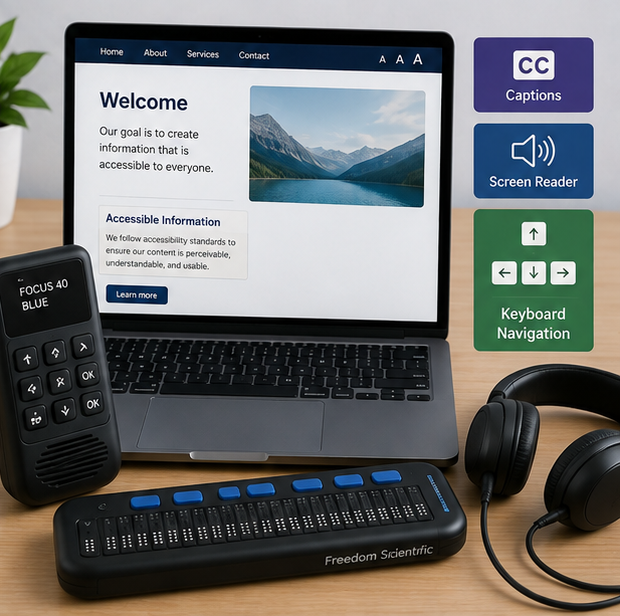
If the information is in an image-based PDF that a screen reader cannot read, the person does not have access to the message. If important information is in an image without alternative text, it may be missed. If a website cannot be navigated with a keyboard, someone who cannot use a mouse may be unable to complete the task. If a video has no captions, someone who is deaf or hard of hearing may miss what is being said.
Sometimes the problem is not the language. Sometimes it is the way the message has been delivered.
Digital accessibility is about making websites, documents, videos, emails and other digital information usable by people with different abilities and different ways of accessing information.

The message is not the format
The message and the format are two different things. If someone needs a screen reader, Braille, Auslan, Key Word Sign or captions, the information has not changed. What has changed is the way that person receives it.
That is why digital accessibility is really a communication issue. At Digital Access Solutions and Assistive Technology, we talk about removing digital barriers so people can access and use information, including websites, documents, emails, videos and other digital communication.
Accessible communication can also make information easier for everyone. Clear headings, simple language, logical structure and different ways of presenting information can improve the experience for people with and without disability.
We all need things translated sometimes.
I needed to learn the language of electrical engineering. A lawyer may need to explain legal terminology to a client. A doctor may need to explain medical terminology to a patient. Someone who speaks English as a second language may need an Australian expression or industry term explained. A person with disability may need information in a format that works with their assistive technology.
None of these people are stupid. They simply need the information communicated in a way that works for them. We all need that sometimes.
So, what language does
your business actually speak?

This is the question I would like businesses to ask. Not just, “Is our website written in English?” but, “Would my customer understand this?”
Would they understand the terminology? Would someone new to your industry understand it? Would someone who speaks English as a second language understand it? Would someone with dyslexia find it easy to follow? Would someone using a screen reader, Braille or captions be able to access it?
If the answer is no, what could you change? Sometimes a simple explanation will help. Sometimes you need to remove unnecessary jargon, provide another format, make the digital information accessible or ask the person what would help them.

Communication starts with
the person receiving the message

We tend to think communication is about what we want to say. It is more useful to think about what the other person needs to receive.
Your customers do not work in your industry. They should not have to become engineers, lawyers, doctors, programmers or accessibility experts just to understand the information you are giving them. They should not have to struggle with your website or documents because you have not considered how they access digital information.
The responsibility for communicating clearly sits with the person sending the message. So before you publish that document, send that email or put information on your website, ask yourself: What language does my business actually speak? And then ask the more important question: Can my customer understand it, access it and use it?
Communication is not finished when we send the message. Communication happens when the other person can access the message and understand what it means.
