Key Word Sign: What and How


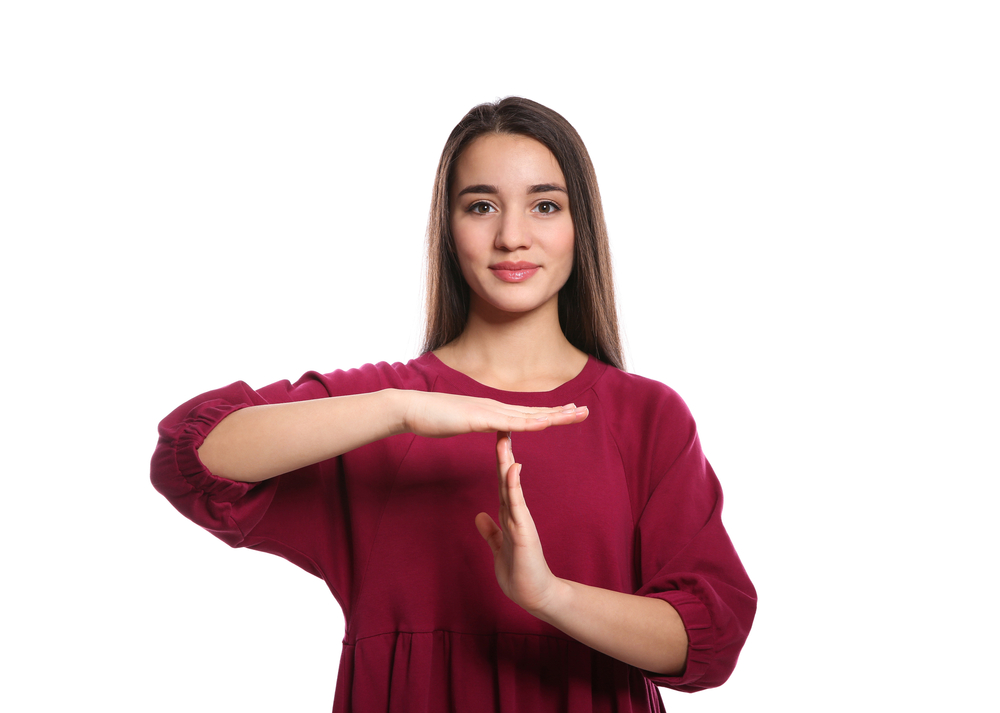
A woman is making a timeout sign. One of the signs in Keyword Sign.

By Libby Brownlie

We all communicate in a range of ways. To share messages, understand information, form connections, and build relationships with others. We may use speech, gestures, sign language, body language, movement, eye gaze, pictures, symbols, and text.

Some children with communication disabilities or difficulties, may need additional support to develop speech, language, and social communication skills. They may benefit from using Augmentative or Alternative Communication (AAC). Some types of AAC involve the use of communication aids, like books, boards, cards, or speech generating devices. We call this ‘Aided AAC’. Other types of AAC rely just on communication using the human body, like facial expressions, body language, gesture, and manual signs. This is called ‘Unaided AAC’. Different types of AAC can be used together to provide a person with a range of communication options that best suit them. This is a multimodal communication approach.

In this article, we’re going to explore Key Word Sign (KWS), an unaided form of AAC.

A sign with the words, What does it mean?

What is Key Word Sign?

Key Word Sign (KWS) is an unaided AAC strategy designed to help children and adults with communication difficulties to understand information and express their message to others. Speech and signs are used together. A full, grammatical sentence is spoken and signs are added to the key words. So, a person hears and sees a message at the same time. For example, in the sentence “It’s time to go to school” you might sign [time], [go] and [school] as you say the sentence. It could look like this:
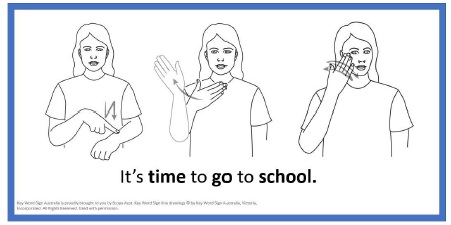
A lady is making the sign for Go to School.

When using signs in a key word approach, you will:

  • Speak and sign at the same time. Auditory and visual information are presented together.
  • Important words are signed. Add a sign to just the key words you want people to pay attention to.
  • Gesture when you communicate. Use your hands, head, and body to add meaning to what you say.
  • Non-verbal communication is important too. Use facial expressions, body movements and eye gaze to enhance your communication.
  • Slow down when you communicate. Take your time and be clear with your spoken and signed message.

Drawings of people with different disabilities. The theme is disability inclusion.

How is Key Word Sign different to sign language?

Key Word Sign is not a language. It is a communication strategy that draws attention to key spoken words, using visual signs. It is a simplified way of signing that follows spoken language word order. When you learn key word sign, you are learning an augmentative or alternative communication strategy.
In contrast, sign languages such as Auslan (Australian Sign Language), are full and rich languages with their own unique rules for production. Sign languages are an integral part of the linguistic and cultural identity of people who are Deaf. When you learn Auslan, you are learning the language of the Deaf community of Australia.

A person thinking with question marks floating around him.

Who uses Key Word Sign?

Key Word Sign is used by people of all ages, who experience communication disability or difficulty. Communication difficulty is often, though not always, associated with a disability either present from birth or acquired. For example, key word sign may be used by children and adults who have been diagnosed with:

  • Down syndrome
  • Autism
  • Intellectual disability
  • Global developmental delay
  • Cerebral Palsy
  • Apraxia or dyspraxia of speech
  • Speech delay or disorder
  • Language delay or Developmental Language Disorder
  • Selective mutism
  • Acquired brain injury or stroke

Key Word Sign and Young Children

For young children with a speech and/or language delay or disorder, key word sign can offer a means of communicating whilst speech and language skills develop. The use of KWS reduces frustration by offering an effective method of communication. It can help facilitate the development of speech and language, and promotes social interaction skills like looking, listening, sharing and turn taking.

Key Word Sign and School-age Children

For school age children, key word sign may be used as part of a multimodal communication approach to support speech, language, social interaction, learning, participation, and inclusion. Other forms of Augmentative and Alternative Communication (AAC) such a communication books, electronic aids or visual supports may also be used. Research shows that KWS used within a classroom and school setting can be a way of including all children, whilst also supporting the preferred communication method of specific individuals.

Key Word Sign and Adults

Some adults with intellectual disability, autism, physical disability, and other sensory disabilities may continue to use KWS throughout their lives. Use of KWS and gesture can be a helpful strategy to support communication in everyday activities and routines. KWS may also be used at times when a person has had a stroke or brain injury and needs access to an immediate, visual communication strategy to share needs and wants and support understanding.

Communication Partners

Whatever the age of the person using KWS as a communication method, the communication partners around that person are important.
It is vital that friends and family members learn to use KWS, to provide an accurate model of signs and to help children and adults expand their sign vocabulary. Teachers, aides and other support workers in schools and adult services also need to use KWS to model communication with signs, and to create a signing environment.
Throughout life, people who continue to use KWS need those they interact, learn, and play with to know KWS. This ensures they can be understood when they use it and so they can learn more signs that will help them communicate about a broader range of topics.


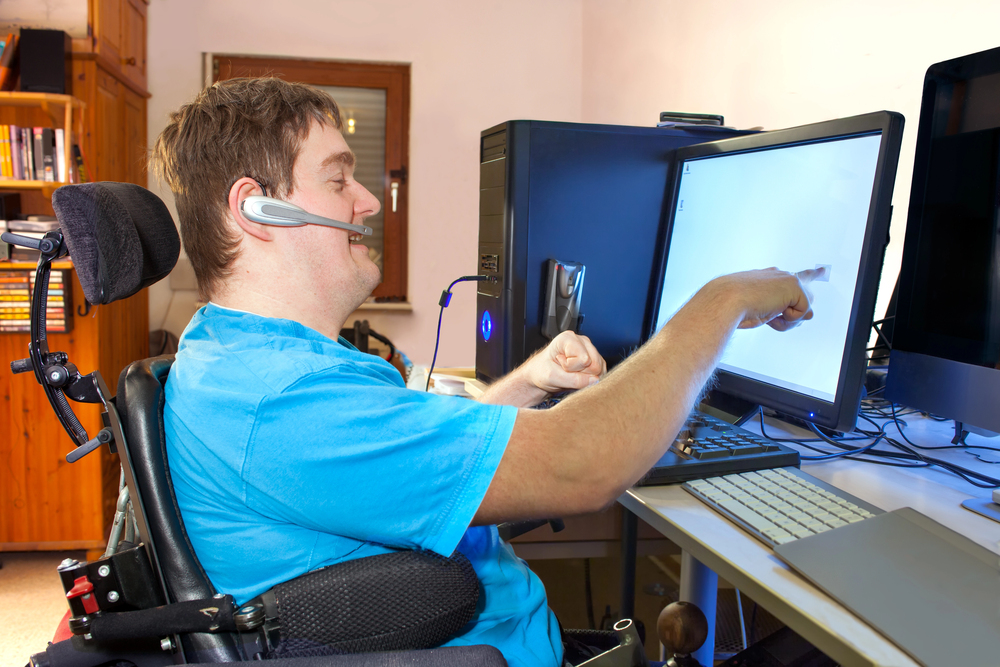
A man with quadriplegia using digital tools to access information.

What are the benefits of Key Word Sign?

Research shows there can be a range of benefits from using a key word sign approach to support communication.

  • Key word sign offers auditory and visual support for communication.
    • When modelling a key word sign approach, you will use both speech and sign. This means the person has opportunity to both hear and see what is being communication, emphasising important concepts and offering a multimodal way to process information.
  • Key word sign encourages eye contact and shared attention.
    • Use of KWS and gesture can also help a person attend to what is happening in their environment. Signing is a visual communication method, so an individual will need to focus their attention on the person signing to see what is being communicated. By pointing out objects, people, events and activities, a person can learn to direct their eye gaze and attention between the communication partner and the environment.
  • Key word sign helps understanding.
    • Speech is usually fast with many sounds, words and often complex sentence structures and ideas. It can be difficult for people with a communication disability to understand what is being said and process important information. Using Key Word Sign and gesture helps us to speak slower, use shorter phrases or sentences, simplify our language, and emphasise the key words using visual signs.
  • Key word sign helps develop vocabulary and language skills.
    • Children and adults with little or no speech often rely on their body language and gestures to get their message across. To be able to develop language skills people need to be able to use more words (increase vocabulary) and to combine them in a way that makes sense (language skills). Key Word Sign and gesture helps children and adults develop and use language in a way that doesn’t rely on speech.
  • Key word sign can support speech attempts.
    • Gestures are an important part of developing communication for young children and are often used before spoken word attempts, for example pointing, waving, holding hands up. Using key word sign and gesture can help to support speech attempts while having access to a way of being understood. Research shows that using Key Word Sign will not stop children from speaking if that is possible for them. Because children are surrounded by speech and will always use what is easiest for them, they will develop speech if they are able to. Key Word Sign is a great bridge to using speech if that is going to be possible. Key Word Sign gives children a way to be part of and learn about communication and how it works – taking turns, asking questions, making comments, using greetings.
  • Key word sign can help reduce frustration arising from communication breakdown.
    • Imagine how you would feel if you were trying to get a message across and no one could understand you. You might gradually give up, withdraw from social interaction, or only communicate about your basic needs. Key Word Sign gives people a way to show how they feel or what they think, and a way of communicating about a wide range of topics. At any age, using both speech and manual signs can offer a way to clarify speech that may be unclear or unintelligible. Also, many signs used in a key word sign approach have a high level of iconicity – the sign looks like what it represents e.g., drink, run, bird. As such, signs can be easily learned and recognised and used, by an individual and by their communication partners.
  • Key word sign supports participation and inclusion.
    • Key word sign is a great way to include everyone in communication and encourage all to join in. Using our hands and bodies to communicate is a natural part of human communication across cultures. So, using gestures and sign alongside speech, encourages everyone to become aware of the diversity of communication and the potential of visual communication supports.

An image with the words, e-learning, linear, computer, web training , classroom, ICT written on it.

How can I learn Key Word Sign?

So, are you interested in learning more about Key Word Sign? Come along to a workshop or get started with some Key Word Sign resources.

Workshops

In a Key Word Sign Basic Workshop, you will learn the principles of a key word sign approach and come away with a core vocabulary of helpful signs that you can use straight away. Delivered in a range of formats including in person, online and via eLearning, a group workshop is a great way to get started with key word sign and meet new people who are also beginning their journey. All are welcome in key word sign workshops and groups will often include a diverse mix of people including parents, family members, teachers, allied health professionals and service providers. To learn more about Key Word Sign workshops you can visit the Key Word Sign Australia website.

Resources

There are many key word sign resources available to purchase or download. From books and posters to downloadable printouts, you can find helpful tools to support your ongoing learning and use of key word sign within everyday activities and routines. When selecting a key word sign resource, it is important to ensure that the signs being used with the key word sign approach are Auslan signs (Australian Sign Language). Some resources available in Australia use American Sign Language (ASL) or British Sign Language (BSL). You can find KWS resources using Auslan signs at: https://kwsa.org.au/resources/ Some training and resources may be eligible for purchase on the NDIS. You can read more about key word sign and the NDIS here: https://kwsa.org.au/ndis/.