You don’t know what you don’t know.
This simple idea sits at the heart of many digital accessibility challenges.
Most businesses are not trying to exclude anyone. Teams genuinely believe their websites, apps, and documents are usable and accessible. The issue is rarely intent. It is a lack of awareness.
From unreadable PDFs that are missing proper structure, to forms that lack clear instructions, to inconsistent date formats that assume shared knowledge, accessibility barriers often go unnoticed by the people creating digital products. These barriers exist not because people are careless, but because they fall outside the everyday experience of those building them.
This lack of awareness is the root reason accessibility issues persist in otherwise well‑intentioned organisations. When barriers are invisible to the people making decisions, they remain unaddressed—regardless of effort or goodwill.

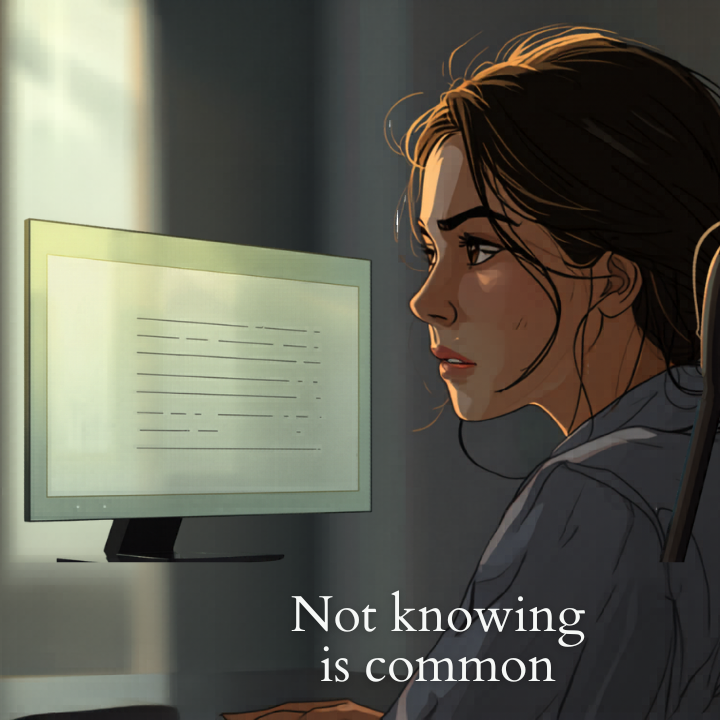
“Not knowing” is common

In many organisations, accessibility is treated as a technical requirement or a compliance task rather than a core part of quality. If it is reviewed at all, it often happens late in a project, after key design and structure decisions have already been made.
By that stage, teams look at what they have built and see a finished product. It loads, it works, it looks fine on their devices. Nothing appears broken.
Testing, when it occurs, is typically shaped by the same assumptions as the build process itself. The people testing are often using the same tools, interaction methods, connectivity, and visual context as the creators. As a result, many barriers are never surfaced because no one involved has reason or ability to perceive them.
This creates a false sense of confidence. Testing confirms what teams already believe, rather than revealing what users actually experience.
If no one involved regularly uses assistive technology, navigates by keyboard, or relies on alternative interaction methods, those gaps remain invisible. The issue is not negligence. It is simply limited perspective.
You cannot fix what you cannot see.
You don’t know what you don’t know.

What changes when awareness happens
You don’t know what you don’t know.
The shift is often immediate when someone finally experiences accessibility barriers firsthand.
It might be listening to a screen reader move through a poorly labelled website, where links make no sense out of context and buttons sound identical. It might be trying to complete a form using only a keyboard and losing track of focus entirely. It might be realising that a video without captions becomes unusable the moment sound is removed.
These moments matter because they replace assumption with reality. Accessibility stops being abstract and becomes tangible. Confusion, delay, and frustration—previously unseen—become undeniable.
This is often the moment when “we think it’s fine” turns into “we need to fix this.”
Not because rules have changed, but because understanding has.
The uncomfortable truth: good intentions are not enough
Many teams believe that caring about users naturally leads to accessible outcomes. This assumption is understandable but flawed.
Accessibility is not determined by intent. It is shaped by exposure.
Teams can genuinely value inclusion and still overlook major barriers if they have never been exposed to ways of using technology different from their own. Buttons that look clear visually may be meaningless when read aloud. Colour contrast that seems acceptable on an office monitor may fail in real‑world conditions. Navigation that feels intuitive with a mouse may break entirely for keyboard users.
Accessibility issues persist not because people do not care, but because these barriers are invisible inside everyday workflows.
“You don’t know what you don’t know” is not a criticism. It is a description of how human perception works. We all design and decide based on our own experience. The problem arises when that experience is too narrow.
Exposure creates better decisions
Once teams are exposed to accessibility barriers, the conversation changes.
This exposure is rarely accidental. It comes from intentionally observing how people interact with digital products using different tools, constraints, and modes of interaction. When that happens, design decisions begin to shift.
Labels become clearer. Navigation becomes more predictable. Content becomes more structured. Teams start asking different questions earlier in the process.
Not “does this look good?”
But “can everyone actually use this?”
This is where accessibility moves out of compliance territory and becomes part of quality. It also improves collaboration. Designers, developers, and content creators gain a shared understanding of what usability really means, reducing rework and strengthening outcomes from the start.

Why this matters beyond compliance

Accessibility is often framed as a legal or regulatory requirement. While those obligations are real, they are not the full story.
Accessibility is about reach.
When people cannot use a website or document, they cannot access the service, information, or opportunity behind it. This affects people with permanent disabilities, but also those in temporary or situational contexts—a broken arm, a noisy environment, ageing eyesight, or a slow internet connection.
When organisations design only for a narrow idea of a “normal user,” they inadvertently exclude a far wider audience than they realise. That exclusion is rarely intentional, but its impact is real.
Exposure reveals how diverse real users actually are—and how fragile many digital experiences become outside ideal conditions.
Bringing it back to DASAT’s core idea

At Digital Access Solutions and Assistive Technology (DASAT), this understanding sits at the centre of our work.
People cannot act on barriers they have never experienced. Exposure bridges the gap between assumption and reality. It turns accessibility from a theoretical concept into something concrete and visible.
Once that shift happens, the conversation changes. It is no longer about whether accessibility matters, but how to do better access.
That is where meaningful, lasting change begins.

Seeing is the beginning of understanding
Most accessibility problems are not hidden because people do not care. They are hidden because people have not yet seen them.
Once those gaps are visible, they are difficult to ignore. The question then becomes not whether accessibility matters, but whether organisations are willing to act on what they can now clearly see.
That is the point where better decisions start.


