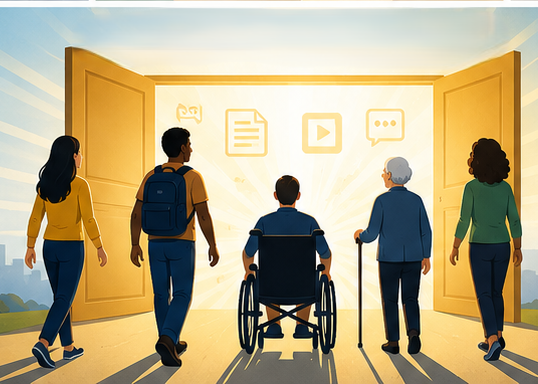
Digital accessibility and power are deeply connected, shaping how people access information, make decisions, and participate in everyday life.
We talk about it in politics, in leadership, in systems and funding. But there is another kind of power that often gets overlooked. It is much quieter, but it shapes daily life in very real ways. It is the ability to access information on your own, without needing someone to step in and translate, explain, or complete things for you.
In a digital world, that kind of power sits inside websites, apps, forms, PDFs, and online systems. When those things are accessible, people can participate independently. When they are not, that independence disappears very quickly.
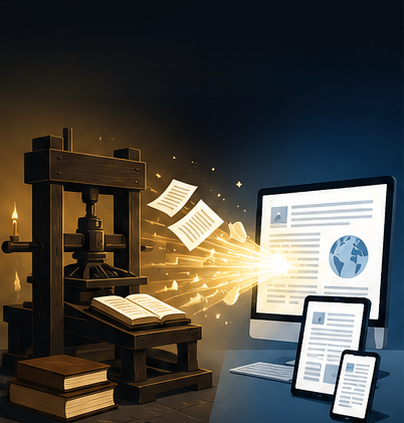
The connection between information and power is not new. We can see it throughout history. One of the most significant shifts occurred during the fifteenth century with the advent of the printing press. Before books and written materials became widely available, knowledge was largely controlled by institutions and educated elites.
As printed materials became more common and information began appearing in the language spoken by everyday people, more people gained access to knowledge that had previously been beyond their reach. They no longer had to rely entirely on others to interpret information for them.
Today, we face a similar challenge. The technology is very different, but the principle remains the same. Information only empowers people when they can actually access it. If websites, documents, apps, and online services are inaccessible, knowledge once again becomes restricted.
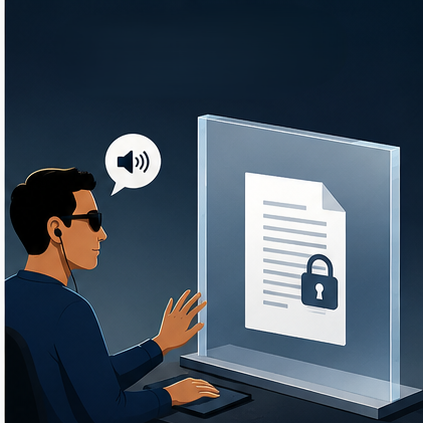
For people with disability, digital inaccessibility is not an occasional inconvenience. It is something that shows up repeatedly in everyday life.
As a person with a severe vision impairment, I regularly encounter barriers when trying to access information independently. Something as simple as reading a utility bill can become difficult. A bank statement or medical information arrives as an image-only PDF. A letter from a government agency cannot be read by my screen reader.
Each time this happens, a little bit of power is taken away. I cannot access the information directly, so I am forced to rely on someone else.
A Deaf person may be unable to access information in a video without captions or Auslan interpretation. Auslan is a fully developed visual language used by the Australian Deaf community, making its inclusion essential for equal access to information.
These barriers are widespread. Globally, over one billion people live with disability, yet most digital content still contains accessibility issues that limit participation.
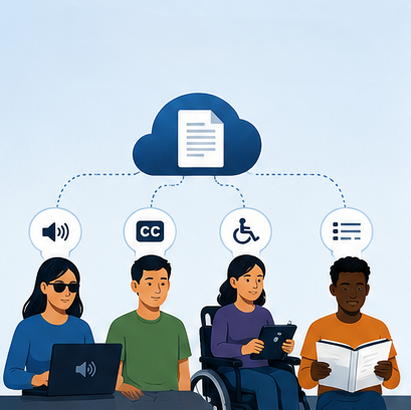
Disability is not one single experience.
For someone who is blind, inaccessible design can prevent basic tasks like reading notices. For someone who is Deaf, missing captions creates immediate exclusion. For people with cognitive disability, complex layouts can be overwhelming.
When digital systems are not accessible, people are pushed into relying on others more than they should have to. That shift might not always be visible, but it changes the balance of independence.
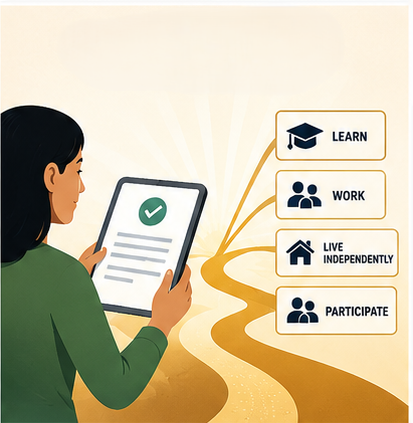
This is where accessibility becomes a question of power.
Because power is not just about who makes decisions. It is also about who can access the information needed to understand those decisions.
The National Disability Insurance Scheme (NDIS) is built around choice and control, supported by policies and legal frameworks that guide how participants interact with services. These can be explored through the NDIS policy framework.
At the same time, organisations operating within this space are expected to meet accessibility obligations, aligning with standards and commitments under the Disability Discrimination Act and accessibility guidelines.
When policy updates are shared in inaccessible formats, dense language, poorly structured documents, or unreadable PDFs, it creates a gap between intention and reality.

The frustrating part is that accessible design is not new. We already know how to do it.
International standards like the Web Content Accessibility Guidelines (WCAG) provide clear direction on how to make digital content accessible. These guidelines outline how content should be perceivable, operable, understandable, and robust for people with disability.
The issue is not knowledge. It is whether accessibility is prioritised from the beginning or treated as an afterthought.
Accessibility is not an extra layer. It is the foundation.
When digital systems are designed well, something shifts. People do not just get access. They gain independence.
Digital accessibility means designing systems so people with disability can interact with information in a meaningful and equivalent way, rather than being excluded or forced to rely on others, yet research shows that the vast majority of websites still fail to meet basic accessibility standards, with most containing significant barriers for users with disability.
The lesson is much the same as it was hundreds of years ago:
When information is accessible, people gain the ability to learn, understand, choose, and act for themselves.
Access creates opportunity.
Access creates independence.
And ultimately, access creates power.